Kuno vs Plaud Note: On-Device, Made-in-Germany Recorder vs the Cloud-AI Original (2026)
Kuno vs Plaud Note (2026): Plaud is a proven ~$159 cloud-AI recorder; Kuno is made-in-Germany, on-device & EU-hosted. Compare specs, privacy, price & verdict.
On this page +
- Kuno vs Plaud Note: the comparison at a glance
- What is the difference between Kuno and Plaud Note?
- Does Plaud transcribe on-device or in the cloud?
- Is Plaud Note GDPR compliant and where is my data stored?
- Where is Plaud based — is it a US company?
- How much does Plaud Note cost compared with Kuno?
- Does Plaud Note work offline?
- Can I use a recorder like this legally in Germany (§ 201 StGB)?
- DACH at a glance: recording a conversation you take part in
- Does Plaud train AI on my recordings?
- Which is better for in-person and field meetings?
- Kuno vs Plaud Note: the verdict and when to choose which
- What are the alternatives to Plaud Note and Kuno?
- Kuno: the on-device, made-in-Germany option
- Common mistakes when choosing between Kuno and Plaud Note
- Troubleshooting: common questions and quick fixes
- FAQ
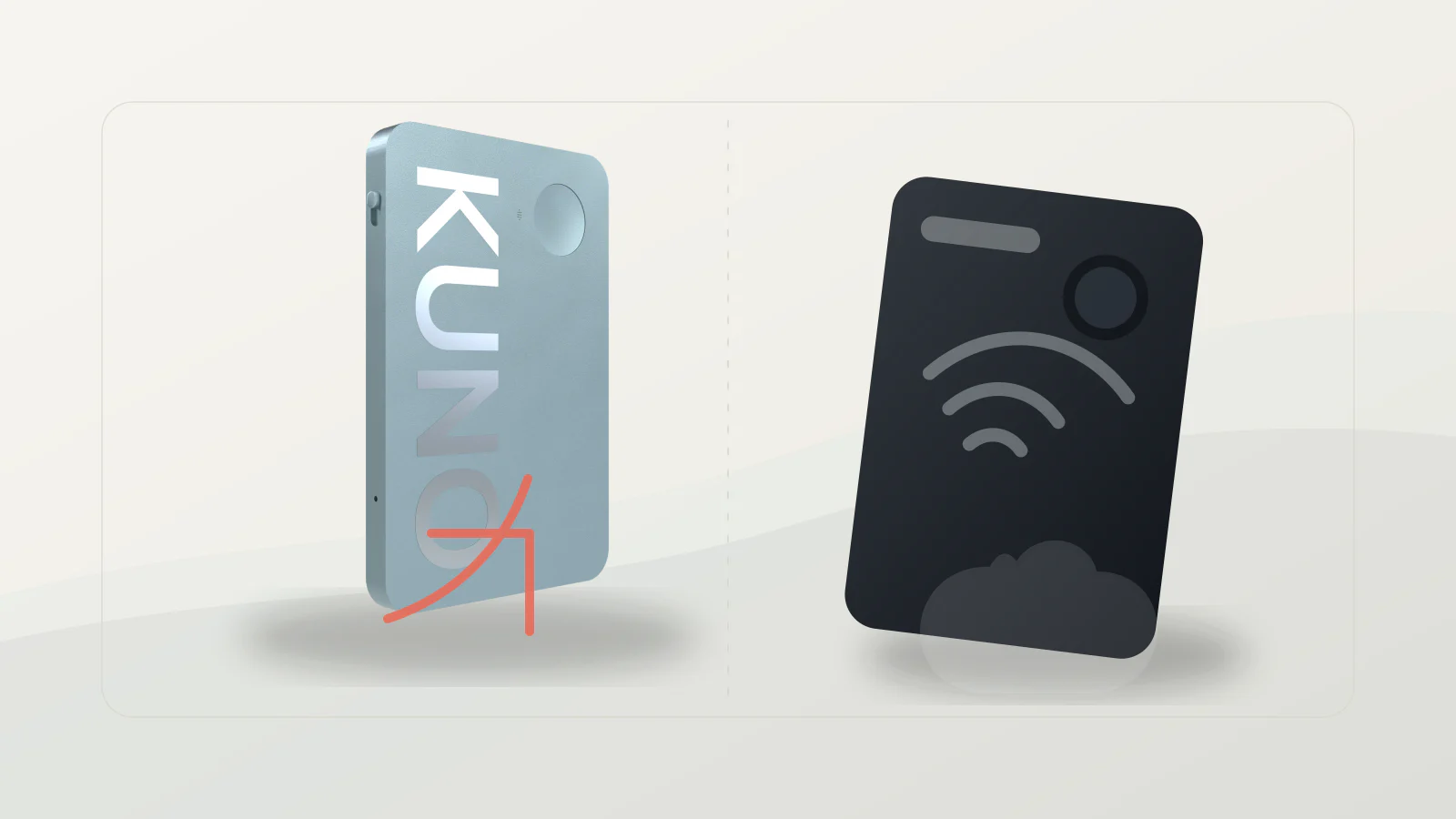
Plaud Note is a proven, credit-card-sized AI voice recorder (from ~$159) that uploads your audio to the cloud for GPT-powered transcription and summaries. Kuno is a privacy-first alternative, made in Germany, that transcribes on-device with EU data hosting — so the audio never leaves the device. Choose Plaud for a mature app and template library today; choose Kuno when data sovereignty and on-device processing are the priority.
🔑 Quick answer • Plaud Note — mature hardware + app, ~$159, MagSafe form factor, cloud transcription (audio uploaded for AI processing), US-headquartered, GDPR-certified, ~30 h recording, 64 GB. Best if you want a polished, ready-today product. • Kuno — made in Germany, on-device transcription (audio never leaves the device), EU-hosted, no training on your recordings, visible recording indicator + one-tap stop. Best if data sovereignty and consent transparency are non-negotiable. • The real difference isn’t compliance — it’s architecture. Plaud is GDPR-compliant and doesn’t train on your data; the distinction is where the AI runs (Plaud: cloud; Kuno: on-device) and who holds jurisdiction (Plaud: US; Kuno: EU/Germany). • Status: Kuno is launching — join the early-access list to compare it directly.
One number frames why this category is exploding: WhatsApp users alone send roughly 7 billion voice messages a day (TechCrunch, citing WhatsApp data, verified June 2026) — proof that spoken capture has gone mainstream, and with it the question of where all that audio is processed. A pocket AI recorder answers the capture problem; only a few answer the data-sovereignty one.
Kuno vs Plaud Note: the comparison at a glance
The two devices solve the same job — capture an in-person conversation and turn it into a transcript and summary — but make opposite architectural choices. Plaud’s specifications below are verified against Plaud’s own product pages and current reviews (June 2026); Kuno’s hardware specs are finalised at launch, so this table is honest about what is and isn’t public yet.
| Dimension | Plaud Note (original) | Kuno |
|---|---|---|
| Form factor | Credit-card size, ultra-thin (~3 mm), MagSafe magnet for the back of a phone | Dedicated pocket recorder (final design at launch) |
| Transcription location | Cloud — audio uploaded to servers for AI transcription & summary | On-device — audio is transcribed locally and does not leave the device |
| AI engine | GPT / enterprise cloud models | On-device model + EU-hosted processing |
| Data hosting | Regional clouds (US, EU, Singapore, Japan); data kept in-region | EU hosting / servers in Germany |
| Company jurisdiction | US — Plaud Inc., San Francisco (offices incl. Shenzhen) | Germany / EU |
| Recording capacity | ~30 h continuous; 64 GB storage | Announced at launch |
| Consent UX | Physical recording control; manual mode switch | Visible recording indicator + one-tap physical stop |
| Training on your data | No (unless you opt in) — GDPR, SOC 2, HIPAA, ISO 27001 certified | No — never used to train AI |
| Price | From ~$159 + optional AI plan (free tier 300 min/mo) | Early-access pricing at launch |
Read the table as a values choice, not a winner-takes-all scorecard: Plaud gives you a finished, feature-dense product right now; Kuno trades the cloud’s convenience for keeping the audio physically on the device and under EU jurisdiction.
What is the difference between Kuno and Plaud Note?
The core difference is where the AI runs and who holds the data. Plaud Note records on the device but sends the audio to cloud servers to transcribe and summarise it (it uses GPT-class models). Kuno performs transcription on-device, so the recording never leaves the hardware, and hosts any account data in the EU. Everything else — form factor, app polish, price — flows from that one decision.
This matters most when the conversation is sensitive: a sales negotiation with pricing, a patient or client consultation, an HR or works-council discussion. With a cloud recorder, that audio is transmitted off the device for processing; with an on-device recorder, it is not.
Does Plaud transcribe on-device or in the cloud?
Plaud transcribes in the cloud. By default, recordings are stored on the device and in the Plaud app, but to transcribe and summarise, the audio is uploaded to Plaud’s servers for AI processing. Plaud encrypts this transmission (TLS 1.2+/1.3 in transit, AES-256 at rest), keeps data in your region’s cloud, and lets you disable optional Cloud Sync — but the AI step itself is server-side. Kuno’s distinction is that the transcription step happens on the device, so there is no audio upload for processing in the first place.
▶ Capture meetings without sending them to a US cloud. Kuno records and transcribes your in-person meetings on a device made in Germany — on-device, EU-hosted, and never used to train AI. The audio stays on the hardware, and a visible recording indicator plus a one-tap stop keep consent transparent. Get early access →
Is Plaud Note GDPR compliant and where is my data stored?
Yes — Plaud has achieved full GDPR compliance and also holds SOC 2 Type II, HIPAA, ISO 27001, ISO 27701 and EN 18031 certifications (verified June 2026). Data is stored in regional clouds (US, EU, Singapore, Japan), so audio stays within your region’s jurisdiction, encrypted in transit and at rest. Plaud being GDPR-compliant is not in question. The nuance some buyers weigh is jurisdiction: Plaud is a US-headquartered company, and US providers can in principle be reached by the US CLOUD Act even for data held abroad. For organisations that want to remove that question entirely, an EU company with EU/German hosting and on-device processing — such as Kuno — is the stricter data-sovereignty choice.
⚠️ Data sovereignty ≠ a compliance verdict. Both approaches can be run lawfully. “EU region” inside a US-owned cloud is not the same guarantee as an EU company processing on-device. Match the choice to your risk profile, not to marketing claims.
Where is Plaud based — is it a US company?
Plaud Inc. is US-headquartered in San Francisco (incorporated in Delaware in late 2021, originally as NiceBuild LLC), with additional teams in Seattle, Tokyo and Shenzhen, China (verified June 2026). That is relevant only for the data-sovereignty question above; it is not a quality judgment. Kuno, by contrast, is built and hosted in Germany, which is the entire premise of its “made in Germany, EU-hosted” positioning.
How much does Plaud Note cost compared with Kuno?
Plaud Note starts at about $159 for the original device (the Plaud Note Pro is around $189 with a larger battery and display), and includes a free AI tier of 300 transcription minutes per month; heavier use moves you to a paid annual plan. Prices vary by region and change over time — check Plaud’s current pricing before buying. Kuno is pre-launch, so its pricing is set at launch and available to early-access members. The honest takeaway: if budget-certainty today is decisive, Plaud’s pricing is public and proven; if on-device processing is the priority, Kuno is the option to evaluate as it opens up.
| Cost element | Plaud Note | Plaud Note Pro | Kuno |
|---|---|---|---|
| Device (approx.) | ~$159 | ~$189 | Early-access pricing |
| Free AI tier | 300 min/month | 300 min/month | Announced at launch |
| Ongoing | Optional paid plan for higher volume | Optional paid plan for higher volume | Announced at launch |
Does Plaud Note work offline?
Plaud Note records offline — audio is captured to the device’s 64 GB storage without a connection — but transcription and summarisation need connectivity, because that processing happens in Plaud’s cloud. So you can capture a meeting in a basement or on a plane, but the transcript appears once you sync. An on-device approach like Kuno’s transcribes locally, which means the text can be produced without an upload step. If you regularly work where there’s no signal and need the transcript immediately, that’s a practical difference worth testing.
Can I use a recorder like this legally in Germany (§ 201 StGB)?
In Germany, the spoken word is specially protected: secretly recording a non-public conversation can be a criminal offence under § 201 StGB, and any recording of identifiable people is personal-data processing that needs a legal basis under the GDPR — usually the consent of everyone involved. This applies to any recorder, Plaud or Kuno; the device doesn’t change the law. What helps in practice is transparency: announce the recording, capture consent, and make it visible that recording is on. Kuno is built for exactly this with a visible recording indicator and a one-tap stop, which makes documenting consent straightforward.
⚠️ General information, not legal advice. Rules differ across the DACH region — see the table below — and by industry. When in doubt, get qualified data-protection or legal advice. (Legal position verified June 2026.)
DACH at a glance: recording a conversation you take part in
| Country | Key rule | Practical takeaway |
|---|---|---|
| Germany (DE) | § 201 StGB protects the non-public spoken word; secret recording can be criminal | Get consent from all parties; make recording visible |
| Austria (AT) | § 120 StGB protects against recording/intercepting non-public statements without consent | Consent of participants; don’t record covertly |
| Switzerland (CH) | Art. 179bis/ter StGB protect non-public conversations; recording without consent is punishable | Inform and obtain agreement before recording |
Across all three, the safe pattern is the same: no covert recording, get consent, and prefer a tool that makes the recording state obvious and keeps the audio under your control.
Does Plaud train AI on my recordings?
No. Plaud states it does not use your recordings to train, optimise or develop AI models unless you explicitly opt in (verified June 2026). On this specific point Plaud and Kuno align — neither trains on your content by default. So “no training” is not a differentiator between them; the differentiators remain on-device vs cloud processing and EU vs US jurisdiction.
Which is better for in-person and field meetings?
Both are hardware recorders built for the in-person meetings that software bots (Otter, Fireflies, Read.ai and similar) can’t reach, because those bots only join Zoom, Teams or Meet calls. That shared strength is the reason to pick either over a meeting-bot. Between the two, the deciding factors are environment and data policy: pick Plaud for the most mature app, templates and battery today; pick Kuno when the meeting content is sensitive enough that on-device processing and EU hosting are the priority.
▶ The meetings a bot can’t join — captured on a device made in Germany. Kuno records your in-person and field meetings, transcribes them on-device, and turns them into a structured summary with action items — EU-hosted, no meeting bot, never used to train AI. A visible recording indicator and one-tap stop keep everyone informed and consent clean. Get early access →
Kuno vs Plaud Note: the verdict and when to choose which
There is no universal winner — there’s a fit. Use this decision shortcut:
| If your priority is… | Choose |
|---|---|
| A polished, proven product you can buy today | Plaud Note |
| The largest template/app ecosystem and biggest battery (Pro) | Plaud Note / Note Pro |
| Audio that never leaves the device (on-device transcription) | Kuno |
| EU/German jurisdiction and data sovereignty | Kuno |
| Visible consent UX for legally sensitive recordings | Kuno |
| Immediate transcripts without connectivity | Kuno (on-device) |
In short: Plaud Note is the better buy if you want the most complete cloud-AI recorder available right now. Kuno is the better fit if on-device processing, EU hosting and consent transparency outweigh having a mature app today — which is exactly the trade many legal, healthcare, public-sector and field-sales teams are making.
What are the alternatives to Plaud Note and Kuno?
If neither fits, the realistic options split by where you meet. For online calls, bot-based assistants like Otter or Fireflies transcribe Zoom/Teams/Meet automatically. For in-person, the field is hardware recorders — Plaud Note/Pro, Sony or Zoom recorders (no built-in AI), or phone-app routes (your phone’s voice recorder plus an AI app). Kuno’s specific niche within that group is the on-device, EU-hosted recorder for in-person meetings. Compare on three axes: where the meeting happens, where the audio is processed, and what jurisdiction holds the data.
Kuno: the on-device, made-in-Germany option
Where Plaud sends audio to the cloud for its AI step, Kuno keeps the whole pipeline on the device and in the EU. The recorder captures the meeting on-device, transcribes locally so the audio never leaves the hardware, and produces a structured summary with action items — EU-hosted and never used to train AI. A visible recording indicator and a physical one-tap stop make it obvious when recording is on, which is what you want for consent under § 201 StGB. It won’t replace Plaud’s years of app polish overnight, but for teams whose first question is “where does the audio go?”, that’s the point.
Common mistakes when choosing between Kuno and Plaud Note
Most regret in this category doesn’t come from picking the “wrong” device — both are capable — but from deciding on the wrong axis. The errors below come up again and again when buyers compare a cloud recorder with an on-device one.
| Mistake | Why it backfires | Do this instead |
|---|---|---|
| Treating “EU region” as EU jurisdiction | A US-owned cloud with a Frankfurt region can still be reached under the US CLOUD Act | Check the provider’s company domicile, not just where the server sits |
| Thinking “no AI training” is the differentiator | Neither Plaud (by default) nor Kuno trains on your recordings — it’s not a tie-breaker | Compare on processing location (cloud vs on-device) and jurisdiction |
| Reading this as a compliance verdict | Plaud is fully GDPR-compliant; framing it as “compliant vs not” is simply wrong | Frame it as a data-sovereignty preference, matched to your risk profile |
| Buying on device price alone for sensitive content | The ~$159 sticker ignores where the audio is processed afterwards | For legal/health/HR content, weigh architecture before price |
| Assuming the device handles consent for you | § 201 StGB and the GDPR apply to any recorder; the hardware can’t grant a legal basis | Announce the recording and capture consent every time — visible indicators help |
| Expecting an instant transcript from a cloud recorder offline | Plaud records offline but needs connectivity to transcribe in its cloud | If you work without signal, test an on-device transcription path |
Troubleshooting: common questions and quick fixes
Practical issues people hit with pocket AI recorders — and what actually resolves them. These apply whichever device you land on.
| Symptom | Likely cause | Fix |
|---|---|---|
| Recording captured, but no transcript appears | Cloud recorders (incl. Plaud) need connectivity to transcribe; you’re offline or not synced | Reconnect and sync; for immediate, no-signal transcripts use an on-device device |
| Worried the audio of a sensitive meeting was uploaded | Cloud transcription sends audio off the device for the AI step | Disable optional cloud sync, or choose on-device processing so audio never leaves the hardware |
| Poor accuracy in a noisy room | Distance, crosstalk and background noise degrade any model | Place the recorder closer to speakers; reduce background noise; review the draft before relying on it |
| Speakers aren’t separated in the transcript | Speaker diarisation isn’t enabled or supported for that recording | Turn on speaker labels where available; note who spoke when capture is critical |
| Participants hesitate when you start recording | Covert or unclear recording erodes trust — and can be unlawful | Use a visible recording indicator and a one-tap stop so consent is obvious and documented |
| Long all-day sessions run out of capacity | Continuous recording fills storage or drains battery | Check rated capacity (Plaud Note ~30 h / 64 GB); split long sessions; charge between meetings |
FAQ
What is the main difference between Kuno and Plaud Note?
Plaud Note uploads audio to the cloud for AI transcription and summary; Kuno transcribes on-device so the audio never leaves the hardware, and hosts data in the EU. Both are hardware recorders for in-person meetings.
Is Plaud Note GDPR compliant?
Yes — Plaud has full GDPR compliance plus SOC 2, HIPAA and ISO 27001 certifications. The data-sovereignty nuance is that Plaud is US-headquartered, so some buyers prefer an EU company with on-device processing for the strictest control.
Does Plaud Note transcribe offline?
It records offline to internal storage, but transcription and summarisation require a connection because they run in Plaud’s cloud. On-device transcription (Kuno) produces text locally without an upload step.
How much does Plaud Note cost?
About $159 for the original Note (~$189 for the Note Pro), with a free tier of 300 transcription minutes per month and optional paid plans. Prices vary by region; check current pricing.
Does Plaud or Kuno train AI on my recordings?
Neither does by default — Plaud only with explicit opt-in, and Kuno never. “No training” is therefore not a difference between them; processing location and jurisdiction are.
Is it legal to record a meeting with one of these in Germany?
Only with the consent of everyone involved — the non-public spoken word is protected under § 201 StGB, and the GDPR needs a legal basis. Make the recording visible and documented. This is general information, not legal advice.
Kuno is a privacy-first AI voice recorder, made in Germany, that captures and transcribes in-person meetings on-device with EU data hosting and no training on your recordings.